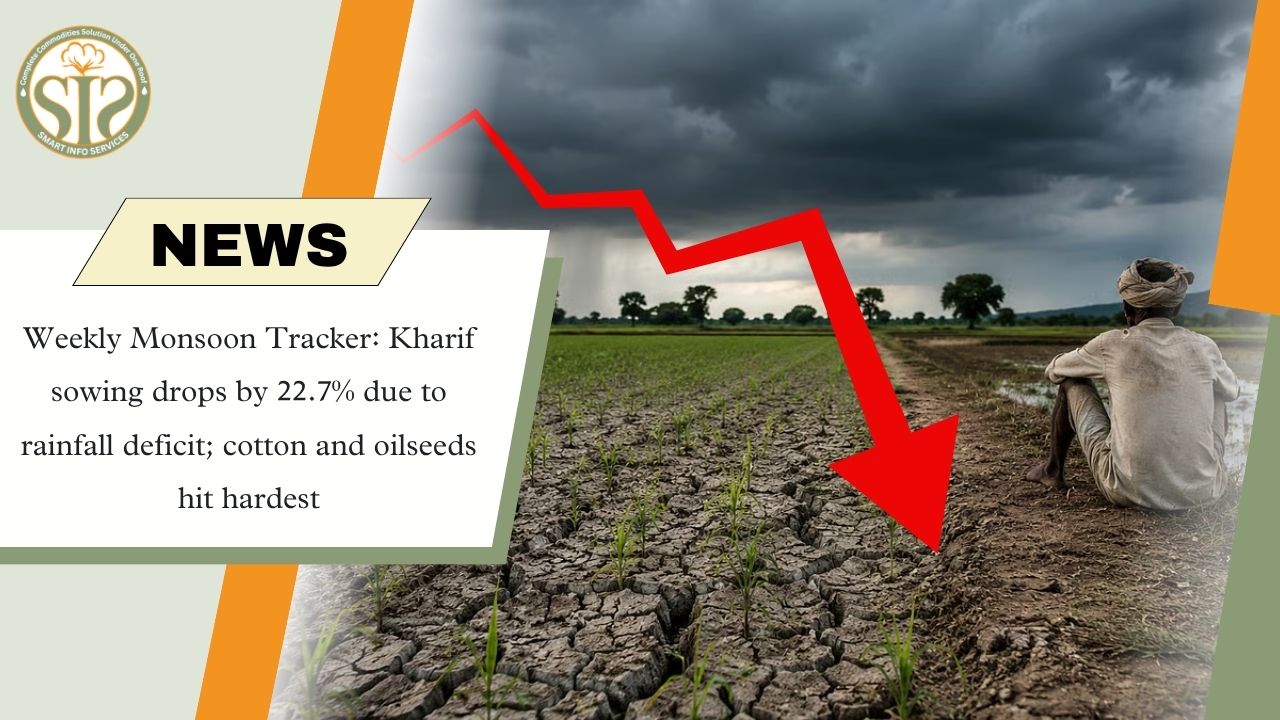
Weekly Monsoon Tracker: Kharif sowing drops by 22.7% due to rainfall deficit; cotton and oilseeds hit hardest
The impact of the monsoon's slow and uneven progress across the country is clearly visible on Kharif crop sowing. Due to rainfall deficits and receding water levels in reservoirs, the sowing of major crops—such as paddy, cotton, oilseeds, and pulses—is lagging significantly behind last year's figures. If adequate rainfall does not occur in July, there are concerns about mounting pressure on agricultural production and food inflation.
According to the latest data from the Ministry of Agriculture and Farmers Welfare, Kharif sowing covered 182.71 lakh hectares by June 25, 2026, compared to 236.47 lakh hectares during the same period last year. This marks a decline of 53.76 lakh hectares, or 22.7 percent, in the total sown area. Meanwhile, the country's rainfall deficit reached 43 percent by June 29. Below-normal rainfall has been recorded in 48 percent of the country, while 26 percent of the area falls under the 'large rainfall deficit' category.
Oilseed crops have been the most severely affected. The acreage for oilseeds dropped from 36.40 lakh hectares last year to 16.98 lakh hectares—a decline of 19.42 lakh hectares. Specifically, soybean sowing fell from 19.97 lakh hectares to 6.92 lakh hectares, while groundnut acreage decreased from 15.29 lakh hectares to 8.87 lakh hectares.
Cotton sowing has also been impacted; its acreage dropped from 45.36 lakh hectares to 29.66 lakh hectares, representing a decline of 15.70 lakh hectares. The area under paddy cultivation has shrunk from 34.41 lakh hectares to 25.75 lakh hectares, while the area sown with pulses has declined from 21.46 lakh hectares to 14.92 lakh hectares. Similarly, the acreage for coarse cereals ('Shree Anna') has decreased from 36.07 lakh hectares to 31.84 lakh hectares.
Alongside the rainfall deficit, the receding water levels in reservoirs are also a cause for concern. Water storage in the country's 166 major reservoirs stands at just 26.4 percent of their total capacity, down from 36 percent during the same period last year. In South India, reservoir levels are at only 20.8 percent of capacity; specifically, levels have dropped from 48.6 percent to 14.7 percent in Karnataka and from 81 percent to 34.3 percent in Tamil Nadu. Water levels in Odisha's reservoirs also stand at a mere 15.3 percent.
Although the India Meteorological Department (IMD) has forecast heavy rainfall in Madhya Pradesh, Chhattisgarh, Odisha, and Vidarbha over the coming days, if rainfall remains below normal in July as well, it could exert pressure on Kharif production, farmers' incomes, and markets linked to pulses, edible oils, and cotton.