India's Cotton Production May Fall 14.3% to 24.87 Million Bales in 2026-27
By yash chouhan 2026-11-28 12:15:50
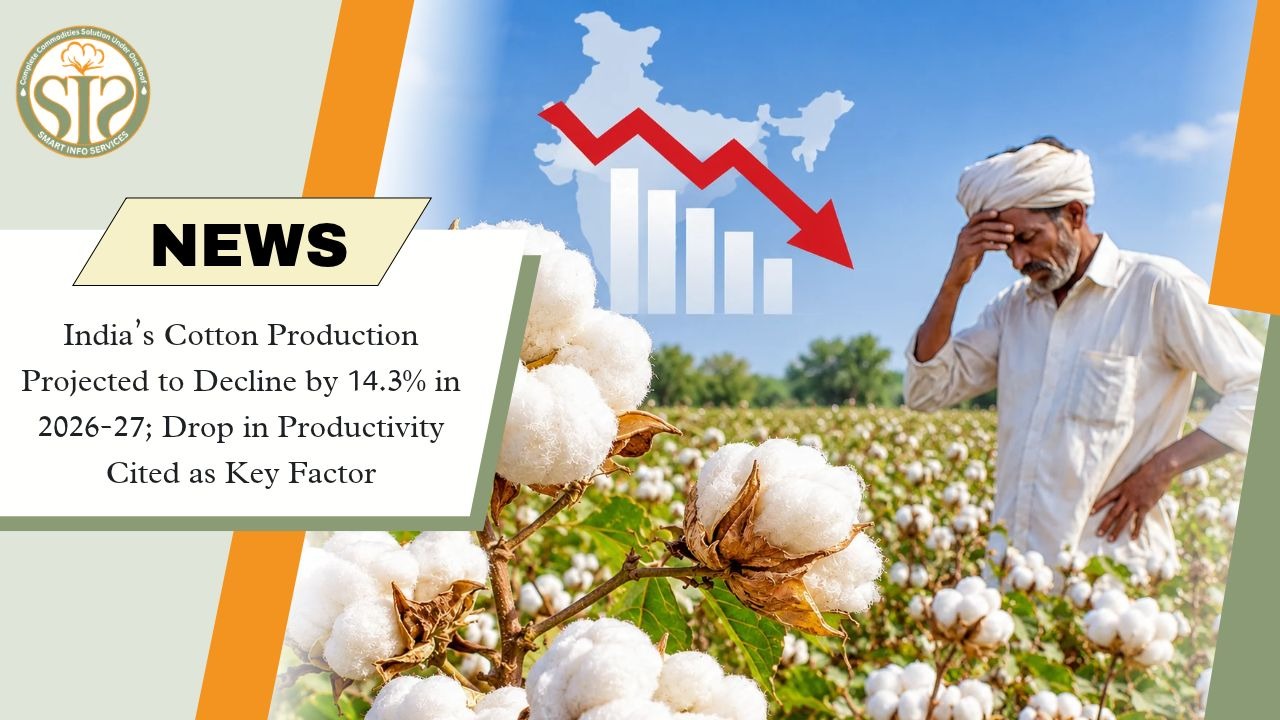
India’s Cotton Production Projected to Decline by 14.3% in 2026-27; Drop in Productivity Cited as Key Factor
New Delhi: Cotton production in India is projected to decline during the current 2026-27 crop season. According to the first advance estimates released by the Department of Agriculture and Farmers Welfare (DA&FW) under the Ministry of Agriculture and Farmers Welfare, cotton production in the country is expected to fall to 24.866 million bales (of 170 kg each)—approximately 4.227 million tonnes. This represents a 14.33% decrease from the 29.024 million bales (4.934 million tonnes) projected in the third advance estimates for the 2025-26 season.
Decline in Acreage and Productivity
The primary reasons for the reduction in output are declines in both the area under cotton cultivation and productivity. It is estimated that the area under cotton in 2026-27 will shrink by 3.78%—from 11.525 million hectares in the previous season to 11.089 million hectares. Meanwhile, average productivity is projected to drop from 428 kg per hectare to 381 kg per hectare—a decline of approximately 10.98%. Data indicates that the drop in productivity is the principal driver behind the overall decline in production.
Fourth Consecutive Season of Declining Production
India is set to witness a decline in cotton production for the fourth consecutive season. Production in the country stood at 33.660 million bales in 2022-23, 32.522 million bales in 2023-24, and 29.724 million bales in 2024-25. For the 2026-27 season, production is now estimated at 24.866 million bales. If this estimate proves accurate, production will be approximately 26.13 percent lower compared to 2022-23.
Potential impact on the international market
A projected decline in production by 4.158 million bales—equivalent to about 707,000 tonnes—could affect both the domestic market and international cotton trade. India is among the world’s leading producers and consumers of cotton. Reduced domestic availability may necessitate higher imports, while the volume of cotton available for export could come under pressure.
An increase in India’s import demand could benefit major cotton-exporting nations such as Brazil, the United States, and Australia. Meanwhile, as Indian spinning mills and textile manufacturers become increasingly reliant on imported cotton, their costs may become susceptible to fluctuations in international prices and currency exchange rates.
In such a scenario, the government’s policy regarding cotton import duties will also be significant. However, these are preliminary estimates and are subject to further revision. The actual impact will depend on final production figures, domestic consumption, opening stocks, and the government’s import policy.