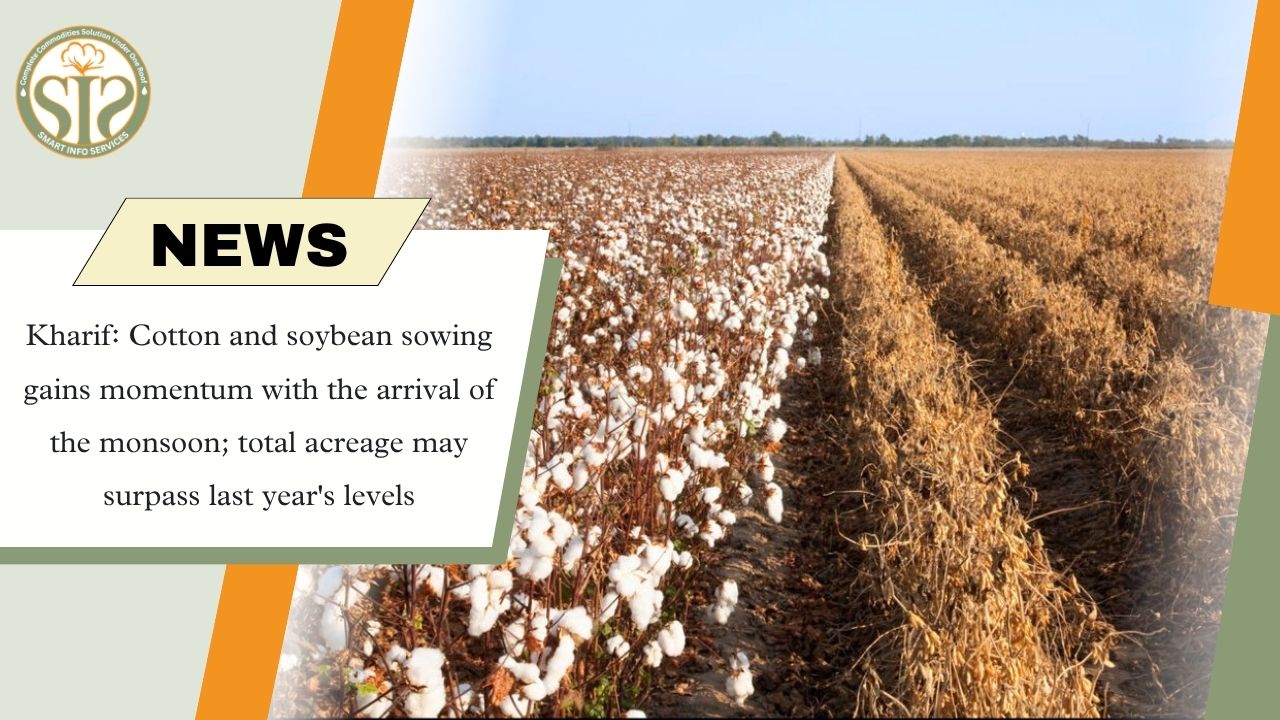
Kharif: Cotton and soybean sowing gains momentum with the arrival of the monsoon; total acreage may surpass last year's levels
Sowing of Kharif crops has accelerated as the Southwest monsoon has covered the entire country. Cultivation of cotton and soybean has picked up pace. According to the Ministry of Agriculture and SOPA, good rainfall has boosted farmer interest and strengthened production prospects.
The Southwest monsoon has now reached the entire country. On July 9, it advanced into the remaining parts of Rajasthan, Haryana, and Punjab, as well as the northern Arabian Sea, completing its nationwide coverage. This has raised expectations for an acceleration in Kharif crop sowing.
Driven by good rainfall, cotton sowing—which was lagging 23 percent behind last year's figures—has gained momentum. As of July 5, the total cotton acreage stood at 63.18 lakh hectares, compared to 82 lakh hectares sown during the same period last year. After lagging in previous weeks, cotton sowing has now picked up in Gujarat, Maharashtra, Karnataka, and Madhya Pradesh. In some areas, farmers are shifting from paddy to cotton and pulses, as these crops offer better prospects. According to the Ministry of Agriculture, cotton production for the year 2025-26 stood at 290.91 lakh bales (each bale weighing 170 kg), which is lower than the 297.24 lakh bales produced in 2024-25.
90 percent of soybean area covered
According to the Soybean Processors Association of India (SOPA), the soybean acreage for the current Kharif season is estimated at 1.003 crore hectares. Sowing has covered approximately 80 to 90 percent of the total target area across key states.
Government estimates indicate that soybean sowing has been completed on 57 lakh hectares so far.
In Madhya Pradesh and Rajasthan, soybean sowing has been completed on approximately 90 percent of the area. In Maharashtra, it has reached approximately 80–90 percent of the target area. SOPA believes that the total soybean acreage during the 2026 Kharif season is likely to surpass last year's levels.