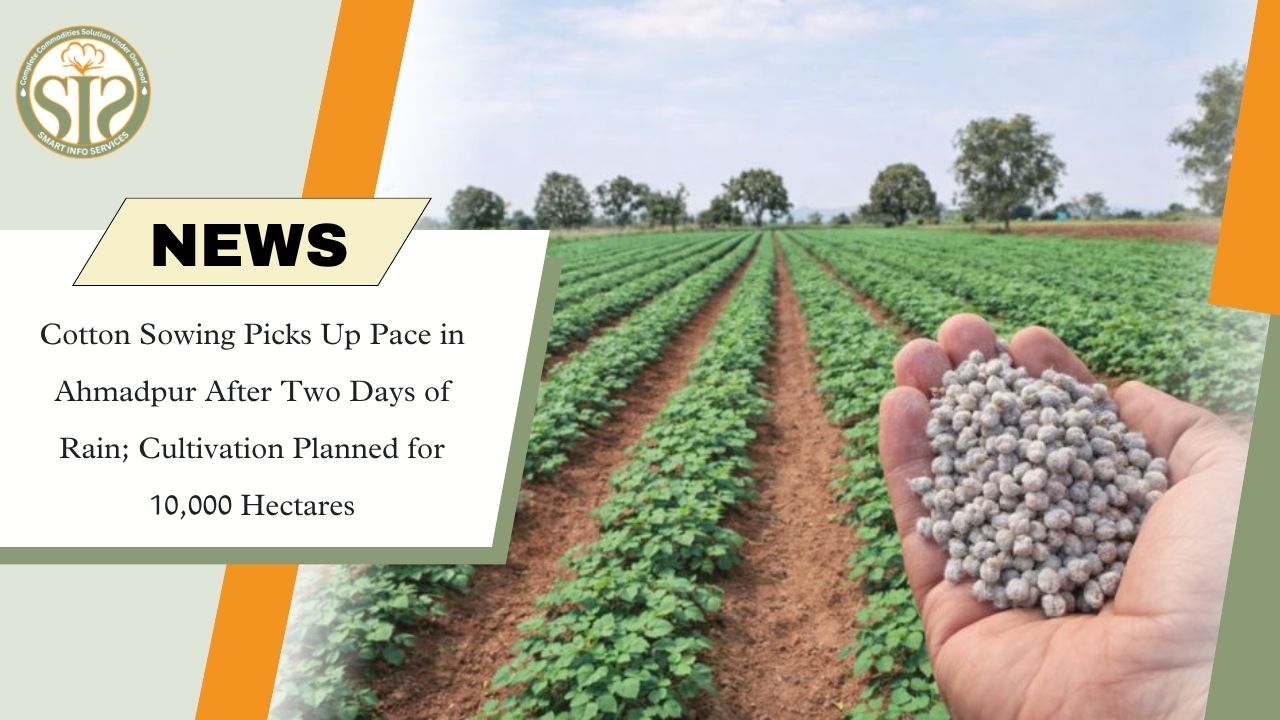
Cotton Sowing Picks Up Pace in Ahmadpur After Two Days of Rain; Cultivation Planned for 10,000 Hectares
Ahmadpur: After a long wait, good rainfall over the past two days has brought relief to farmers in Ahmadpur Taluka. Farmers had been anxious due to the lack of rain during the first half of the monsoon's 'Mrig Nakshatra' period; however, with adequate soil moisture now available, cotton sowing operations have accelerated. Cotton is the taluka's second most important Kharif crop after soybean, and the target for this year is to cultivate it across approximately 10,000 hectares.
With the Meteorological Department forecasting further rainfall, farmers have ramped up sowing activities. Moderate rainfall was recorded in several parts of the taluka on Saturday. Following this, farmers in villages such as Shirur Tajband, Ahmadpur, Nandura, Dhalegaon, Hadolti, and Thodga have headed to their fields.
For this Kharif season, the total cultivable land in Ahmadpur Taluka is 71,482 hectares, with a total sowing area of 66,587 hectares. Soybean cultivation will cover the largest area at 44,622 hectares. This is followed by a planned 10,000 hectares for cotton and 9,797 hectares for Arhar (Tur/pigeon pea).
Rainfall data indicates that 23 mm of rain was recorded in the Ahmadpur circle by June 27, bringing the cumulative total to 112 mm. The Shirur Tajband circle also received 23 mm of rain, reaching a total of 94 mm. Meanwhile, only 9 mm (total 49 mm) was recorded in the Khandli area, and 7 mm (total 23 mm) in the Andhori area. No rainfall occurred in the Kinggaon and Hadolti circles on that day. Kinggaon has received only 28 mm of rain so far, so farmers there are still awaiting significant rainfall.
Sowing remains stalled in areas where soil moisture levels are insufficient. Following two consecutive days of rainfall in the Hadolti region, farmers have commenced sowing both cotton and soybean crops. They are hopeful that further good rainfall in the coming days will ensure the successful completion of sowing operations.
Vishwanath Hengne, a farmer from Hadolti, stated, "We received good rainfall last June, and a rainy spell has begun this time as well. If there is substantial rainfall over the next day or two, the cotton sowing process will be fully successful."
Taluka Agriculture Officer Sachin Bavge advised farmers against hasty sowing. According to him, it is advisable to sow only after receiving at least 100 mm of rainfall and ensuring adequate soil moisture. He emphasized the importance of checking seed germination capacity and performing seed treatment prior to sowing. He also noted that adopting the Broad Bed Furrow (BBF) or dibbling method saves seeds and fertilizer while enabling the crop to better withstand erratic rainfall. Additionally, he urged farmers to utilize the 'Mahavistar AI' app for weather forecasts, pest management, and modern agricultural advice.